Prime Time – Awesome Guide For Class 6 Math Chapter 5

Welcome to iPrep, your Learning Super App. Our learning resources for the chapter, Prime Time in Mathematics for Class 6th are designed to ensure that you grasp this concept with clarity and perfection. Whether you’re studying for an upcoming exam or strengthening your concepts, our engaging animated videos, practice questions and notes offer you the best of integrated learning with interesting explanations and examples. 

The chapter Prime Time introduces students to the fundamental concepts of prime and composite numbers. It explores the idea that a prime number has exactly two distinct factors: 1 and the number itself, while a composite number has more than two factors. The chapter also covers the concept of divisibility, helping students understand how to determine if one number is divisible by another. Additionally, students learn about the importance of prime factorization, which involves breaking down a number into its prime factors, a crucial skill that lays the foundation for more advanced topics in mathematics.

Prime Time

Common Multiples and Common Factors

Let’s start the chapter of prime time with a fun game (Idli-Vada Game) that you can play with your friends! Imagine you’re sitting in a circle with other children, and the game is all about numbers.

  • One child starts by saying “1”.
  • The second player says “2”, and so on.
  • But when it’s the turn of multiples of 3 (like 3, 6, 9…), the player should say “idli” instead of the number.
  • When it’s the turn of multiples of 5 (like 5, 10, 15…), the player should say “vada” instead of the number.
  • If a number is a multiple of both 3 and 5 (like 15), the player should say “idli-vada”!

If a player makes a mistake, they are out of the game. The game continues in rounds until only one player remains.

Key Questions:

  • For which numbers should players say “idli”? These would be 3, 6, 9, 12, 15, 18, and so on.
  • For which numbers should players say “vada”? These would be 5, 10, 15, 20, 25, and so on.
  • Which is the first number for which players should say “idli-vada”? The answer is 15, as it is a multiple of both 3 and 5. Such numbers are called Common Multiples.

Jump Jackpot: A Game of Multiples

Let’s understand the chapter prime time further with a game. In this game, Jumpy and Grumpy are playing a treasure hunt game. Grumpy places a treasure on a number, say 24, and Jumpy has to jump on multiples of a chosen jump size, starting from 0, to reach the treasure.

For example, if Jumpy chooses a jump size of 4, he will jump on 4 → 8 → 12 → 16 → 20 → 24, successfully landing on 24.

Other successful jump sizes for 24 include 2, 3, 6, 8, 12, and 24.

But what happens if there are two treasures, placed on different numbers like 14 and 36? Jumpy needs to choose a jump size that lands on both numbers.

  • Factors of 14: 1, 2, 7, 14
  • Factors of 36: 1, 2, 3, 4, 6, 9, 12, 18, 36

Common Factors of 14 and 36 are 1 and 2. So, Jumpy should choose a jump size of 1 or 2 to land on both treasures. 

Common Factors or Divisors are the numbers that can divide both numbers exactly.

Perfect Numbers

As stated in the chapter prime time, a number for which the sum of all its factors is equal to twice the number is called a Perfect Number

The number 28 is an example of a perfect number. Its factors are 1, 2, 4, 7, 14, and 28. Now let’s explore another very important topic of the chapter Prime Time, named perfect numbers.

Prime Numbers

Definition: Numbers with only two factors are called Prime Numbers.

Example:

Guna and Anshu are arranging figs (anjeer) in boxes.

  • Guna wants to put 12 figs in each box.
  • Anshu wants to put 7 figs in each box.

Guna can arrange the 12 figs in multiple ways:

  • 1 row of 12 figs
  • 2 rows of 6 figs
  • 3 rows of 4 figs
  • 4 rows of 3 figs
  • 6 rows of 2 figs

However, Anshu can only arrange the 7 figs in one way:

  • 1 row of 7 figs

This difference is because 12 has more than two factors, while 7 has only two factors—1 and 7. Now let’s explore another topic of the chapter prime time named Prime vs. Composite Numbers.

Prime vs. Composite Numbers

  • Prime Numbers have only two factors: 1 and the number itself. Examples include 2, 3, 5, 7, 11, 13, 17, 19.
  • Composite Numbers have more than two factors. Examples include 4, 6, 8, 9, 10, 12, 14, 15, 16, 18, 20.

Note: The number 1 is neither a prime nor a composite number.

The Sieve of Eratosthenes: Finding Prime Numbers
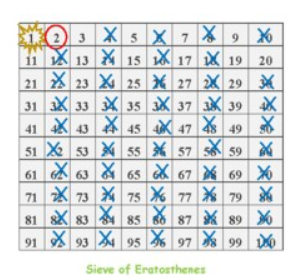
image 178

Here’s an ancient method to find prime numbers:

  1. Cross out 1 because it is neither prime nor composite.
  2. Circle 2, then cross out all multiples of 2.
  3. Circle 3, then cross out all multiples of 3.
  4. Circle 5, then cross out all multiples of 5.

Continue this process until all numbers are either circled (primes) or crossed out (composites). This method is called the Sieve of Eratosthenes. Now let’s explore the another topic of prime time names twin primes.

Twin Primes

According to the chapter Prime Time, twin primes are pairs of prime numbers with a difference of 2. Examples include 3 and 5, 17 and 19. 

Co-prime Numbers: Safe Keeping Treasures

In the treasure hunt game, Jumpy has to reach two treasures placed on different numbers using the same jump size, but with a new rule: the jump size of 1 is not allowed.

To ensure Jumpy cannot reach both treasures, Grumpy should place them on numbers that have no common factors other than 1, called Co-prime Numbers.

For example:

  • 12 and 26 are not co-prime because they have a common factor of 2.
  • 4 and 9 are co-prime because they have no common factors other than 1.

Prime Factorisation: Breaking Down Numbers

As stated in the chapter Prime Time, when checking if two numbers are co-prime, a systematic approach called Prime Factorisation is used.

For example:

  • Prime Factorisation of 56: 56 = 2 × 2 × 2 × 7
  • Prime Factorisation of 63: 63 = 3 × 3 × 7

These factors are all primes, and the product of these prime factors gives the original number.

Key Points:

  • Every number greater than 1 has a prime factorization. 
  • The idea is the same: keep breaking the composite numbers into factors till only primes are left. 
  • The number 1 does not have any prime factorization. It is not divisible by any prime number.

Here, you see four different ways to get a prime factorization of 36. Observe that in all four cases, we get two 2s and two 3s. Multiply back to see that you get 36 in all four cases.
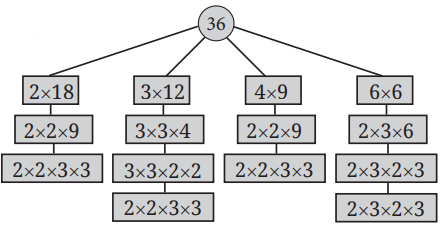
An illustration of prime factorization from the chapter prime time from class 6 math

Does the order matter?

When multiplying numbers, we can do so in any order. The end result is the same. That is why, when two 2s and two 3s are multiplied in any order, we get 36.

Thus, the order does not matter. Usually, we write the prime numbers in increasing order. For example, 225 = 3 × 3 × 5 × 5 or 30 = 2 × 3 × 5. 

Prime Factorization of a Product of Two Numbers

When we perform prime factorization, we start by expressing a number as a product of two factors. For example, 72 can be written as 12 × 6. We then find the prime factorization of each factor:

  • 12 = 2 × 2 × 3
  • 6 = 2 × 3

By combining these, the prime factorization of 72 is:

  • 72 = 2 × 2 × 3 × 2 × 3
  • This can also be written as 2 × 2 × 2 × 3 × 3.

Always remember to multiply the factors to verify that you get the original number, 72, in this case. 

Notice how each prime factor appears a specific number of times in the factorization of 72, compared to how they appear in the factorization of 12 and 6 individually.

Using Prime Factorization to Check Co-prime Numbers

Co-prime numbers are pairs of numbers that have no common prime factors. Let’s explore this with an example:

  • 56 = 2 × 2 × 2 × 7
  • 63 = 3 × 3 × 7

Since 7 is a common prime factor in both 56 and 63, they are not co-prime.

Consider another pair:

  • 80 = 2 × 2 × 2 × 2 × 5
  • 63 = 3 × 3 × 7

Here, there are no common prime factors, so 80 and 63 are co-prime.

Additional Examples:

  • 40 = 2 × 2 × 2 × 5
  • 231 = 3 × 7 × 11

Since they have no common prime factors, 40 and 231 are co-prime.

  • 242 = 2 × 11 × 11
  • 195 = 3 × 5 × 13

Again, no common prime factors exist, so 242 and 195 are co-prime.

Using Prime Factorization to Check Divisibility

If one number is divisible by another, the prime factorization of the second number will be a part of the prime factorization of the first. Let’s look at an example:

Example 1: Is 168 divisible by 12?

  • 168 = 2 × 2 × 2 × 3 × 7
  • 12 = 2 × 2 × 3

Since the prime factors of 12 are included in the prime factorization of 168, 168 is divisible by 12.

Example 2: Is 75 divisible by 21?

  • 75 = 3 × 5 × 5
  • 21 = 3 × 7

Since 7 is a prime factor of 21 but not of 75, 75 is not divisible by 21.

Example 3: Is 42 divisible by 12?

  • 42 = 2 × 3 × 7
  • 12 = 2 × 2 × 3

Since factor 2 appears twice in 12 but only once in 42, 42 is not divisible by 12.

Divisibility Tests: Simplifying Factorization for Large Numbers

As stated in the chapter Prime Time, finding factors of smaller numbers is straightforward, but what about larger numbers? 

Let’s take 8560 as an example. Does it have any factors from 2 to 10? 

We can easily determine this without long division by applying simple divisibility rules.

  1. Divisibility by 10

       To check if a number is divisible by 10, observe the last digit:

  • Numbers ending in 0 are divisible by 10.

             Example: Is 8560 divisible by 10?

                                Yes, because it ends in 0.

  1. Divisibility by 5

             Similarly, a number is divisible by 5 if it ends in 0 or 5.

            Example: Is 8560 divisible by 5?

                   Yes, because it ends in 0.

  1. Divisibility by 2

              A number is divisible by 2 if its last digit is 0, 2, 4, 6, or 8.

              Example: Is 8560 divisible by 2?

                 Yes, because it ends in 0.

  1. Divisibility by 4

Checking divisibility by 4 involves looking at the last two digits. If they form a number divisible by 4, then the whole number is divisible by 4.

              Example: Is 8536 divisible by 4?

                 Yes, because 36 is divisible by 4.

  1. Divisibility by 8

For divisibility by 8, check the last three digits. If they form a number divisible by 8, then the entire number is divisible by 8.

             Example: Is 8560 divisible by 8?

                  No, because 560 is not divisible by 8.

Special Numbers and Fun with Prime Numbers

As stated in the chapter Prime Time, special numbers often have unique characteristics. 

Let’s explore some examples:

Consider the numbers 9, 16, 25, 43. Each has something special:

  • 9 is the only single-digit number.
  • 16 is the only even number and a multiple of 4.
  • 25 is the only multiple of 5.
  • 43 is the only prime number and not a perfect square.

A Prime Puzzle

Lastly, try your hand at a prime number puzzle! It’s a fun way to engage with primes and their properties.

Rules:  Fill the grid with prime numbers only so that the product of each row is the number to the right of the row and the product of each column is the number below the column.

Example:

      75
      42
      102
170 30 63 X

Solution

5 5 3 75
2 3 7 42
17 2 3 102
170 30 63 X

In conclusion, Chapter 5 of CBSE Class 6th Math, “Prime Time,” provides a foundational understanding of prime and composite numbers, along with essential concepts such as divisibility, common factors, and prime factorization. By exploring the distinction between prime and composite numbers, students can build a strong mathematical base. Prime Time is filled with interactive games and activities that make learning these topics engaging and fun. Whether it’s understanding prime factorization or playing with common multiples, the lessons in Prime Time are crucial for grasping higher-level math concepts. Be sure to explore all the resources iPrep offers for Prime Time to master these essential math skills!


To read the NCERT text of  Maths Chapter 5 Prime Time, click here.

Practice questions on Chapter 5 - Prime Time!

Get your free Chapter 5 - Prime Time! practice quiz of 20+ questions & detailed solutions

Practice Now

Math

Chapter 5 - Prime Time!

Power Up Learning with iPrep
Fill the Form to Begin!

Download the App

Watch lectures, practice questions and take tests on the go.

Number Play – The Best Guide For Class 6 Math Chapter 3

Welcome to iPrep, your Learning Super App. Our learning resources for the chapter, Number Play in Mathematics for Class 6th are designed to ensure that you grasp this concept with clarity and perfection. Whether you’re studying for an upcoming exam or strengthening your concepts, our engaging animated videos, practice questions and notes offer you the best of integrated learning with interesting explanations and examples. 

The Chapter Number Play explores the intriguing world of numbers through various engaging activities. It highlights how numbers are used to organize our lives and solve problems, encouraging students to observe patterns and play with numbers in creative ways. The chapter covers concepts such as identifying numbers based on patterns, understanding supercells, exploring digit sums, palindromic numbers, and the famous Kaprekar’s magic number. It also introduces students to the Collatz Conjecture, a still-unsolved mathematical mystery, and emphasizes the importance of estimation and strategic thinking through games. This chapter is designed to make learning about numbers both fun and insightful.

Number Play

Numbers are everywhere. They help us organize our lives, solve problems, and understand the world around us. We’ve used numbers to count, add, subtract, multiply, and divide in our daily lives. But numbers are much more than that—they have patterns, mysteries, and games hidden within them. 

Numbers Can Tell Us Things

According to the chapter Number Play, numbers can communicate interesting things about the world. 

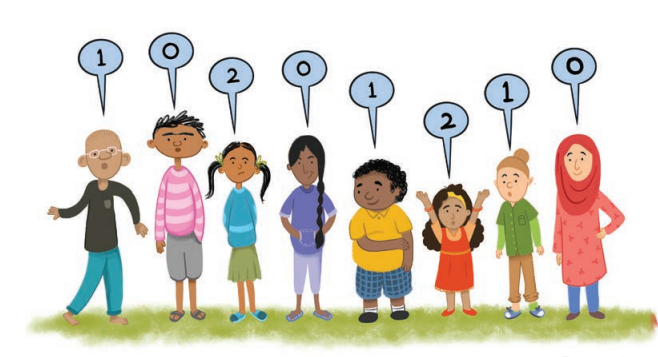
Imagine a group of children standing in a line in a park. Each child says a number. What do these numbers mean? Could their heights be playing a role?

a visual illustration of playing with numbers from the chapter number play from lass 6th math
  • A child might say ‘1’ if only one taller child is standing next to them. 
  • Another might say ‘2’ if both children next to them are taller. 
  • A child says ‘0’ if neither of the children standing next to them is taller. 

In this way, each person says the number of taller neighbors they have. 

Numbers can tell us more than just a count—they can give us insight into relationships and arrangements.

Supercells: The Hidden Power of Numbers

Observe the numbers in the table below. 

Some numbers are colored—why?

43 79 75 63 10 29 28 34
200 577 626 345 790 694 109 198

A cell is colored if the number in it is larger than its adjacent cells. 

For example, 626 is colored because it is larger than 577 and 345. 

Similarly, 198 is colored as it is larger than the only adjacent cell, 109. 

Patterns of Numbers on the Number Line

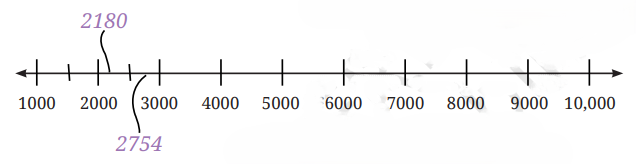
We are familiar with number lines, but according to the chapter Number Play, they can reveal surprising patterns when we place numbers on them. 

Let’s try placing these numbers on a number line: 

2180, 2754, 1500, 3600, 9950, 9590, 1050, 3050, 5030, 5300, and 8400.

image 172

Playing with Digits

We start writing numbers from 1, 2, 3, and so on. There are nine 1-digit numbers. But as stated in the chapter number play, how many numbers have two digits, three digits, four digits, and five digits?

  • 1-digit numbers: 1–9 (9 numbers)
  • 2-digit numbers: 10–99
  • 3-digit numbers: 100–999
  • 4-digit numbers: 1000–9999
  • 5-digit numbers: 10000–99999

Digit Sums

Based on the chapter Number Play, when we add up the digits of certain numbers, the sum is the same. 

For example, the digit sum of 68 is the same as the digit sum of 176 or 545. 

 i.e.   6+8 = 14

        1+7+6 = 14

        5+4+5 = 14

Digit Detectives 

Further in the chapter number play, we’ll understand the concept of digit detectives. Let’s write numbers from 1 to 100, now understand how many times the digit ‘7’ appeared. 

  • Counting the digit ‘7’ in the units place:

The numbers where ‘7’ appears in the units place are: 7, 17, 27, 37, 47, 57, 67, 77, 87, 97.

There are 10 numbers where ‘7’ appears in the units place.

  • Counting the digit ‘7’ in the tens place:

The numbers where ‘7’ appears in the tens place are: 70, 71, 72, 73, 74, 75, 76, 77, 78, 79.

There are 10 numbers where ‘7’ appears in the tens place.

  • Counting the digit ‘7’ in the number 77:

Note that the number 77 has ‘7’ in both the tens and units place, so it has been counted twice (once in the tens place and once in the units place). Now that we understand digit detectives lets understand another topic of the chapter number play named Total Count.

Total Count

Adding the appearances in both places gives us:

  • 10 appearances in the units place
  • 10 appearances in the tens place

So, the total number of times the digit ‘7’ appears from 1 to 100 is:

10+10=20 times10 + 10 = 20 times

Thus, the digit ‘7’ appears 20 times when writing the numbers from 1 to 100.

In the same way, we can find out the digit ‘7’ appeared among  the numbers 1–1000? The answers might surprise you!

Pretty Palindromic Patterns

What do these numbers have in common: 66, 848, 575, 797, 1111? They are palindromes, meaning they read the same from left to right and from right to left.

  • All Palindromes Using 1, 2, 3: The numbers 121, 313, and 222 are some examples of palindromes using the digits ‘1’, ‘2’, and ‘3’. 
  • Reverse-and-Add Palindromes: Start with a 2-digit number. Add this number to its reverse. If you get a palindrome, stop. If not, repeat the steps of reversing the digits and adding until you do.

For Instance, 48+84 = 132 +231 = 363

The Magic Number of Kaprekar

D.R. Kaprekar was a mathematics teacher who discovered a magical phenomenon with 4-digit numbers. Here’s how you can experience the magic yourself:

  1. Pick any 4-digit number with at least two different digits, say 6382.
  2. Make the largest number from these digits and call it A.
  3. Make the smallest number from these digits and call it B.
  4. Subtract B from A to get C .i.e C = A – B
  5. Repeat the process with C.

You’ll notice that after a few steps, you will always reach the number 6174!, known as Kaprekar’s constant. No matter what 4-digit number you start with (as long as it has at least two different digits), you will eventually arrive at 6174!

Example

Take a 4-digit number like 3215. Rearranging to form the largest and smallest with these digits, we get 5321 and1235. Now, subtract them: 5321-1235 = 4086. Continue with the process of rearranging and subtracting:

  • 8640−0468=8172
  • 8721−1278=7443
  • 7443−3447=3996
  • 9963−3699=6264
  • 6642−2466=4176
  • 7641−1467=6174.

Clock and Calendar Numbers

According to the chapter number play, on a 12-hour clock, certain times have interesting patterns, like 4:44, 10:10, and 12:21. 

Examples

  • Manish’s birthday is on 20/12/2012, where the digits ‘2’, ‘0’, ‘1’, and ‘2’ repeat in that order. 
  • Meghana’s birthday is on 11/02/2011, where the digits read the same from left to right and from right to left. 

Let’s understand

 Jeevan noticed that the calendar changes every year. But can a year’s calendar repeat after some years? Can you find out if any year’s calendar will match exactly with that of another year?

Yes, a year’s calendar can repeat after some years. The repetition of a calendar depends on two factors: the day of the week the year starts on and whether the year is a leap year or not.

When Does a Calendar Repeat?

  • Same Day of the Week: For a calendar to repeat, the new year must start on the same day of the week.
  • Same Type of Year: Both years must be either leap years or non-leap years.

General Rule

  • A common year (non-leap year) calendar repeats after 6 or 11 years.
  • A leap year calendar repeats every 28 years.

Mental Math

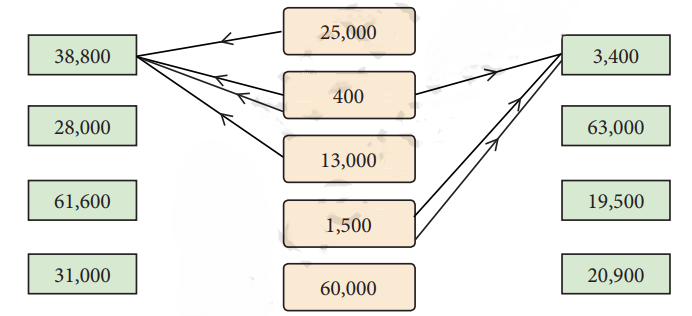
Fiurther in the chapter number play, we’ll be doing some mental math. Observe the figure below. What can you say about the numbers and the lines drawn? 

image 169

Numbers in the middle column are added in different ways to get the numbers on the sides. For example, 1500 + 1500 + 400 = 3400. The numbers in the middle can be used multiple times to achieve the desired sum. 

Two examples are given. It is simpler to do it mentally! 

  • 38,800 = 25,000 + 400 × 2 + 13,000 
  • 3400 = 1500 + 1500 + 400

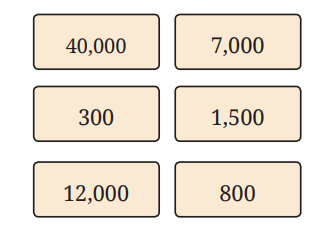
Adding and Subtracting: Using the numbers in the boxes, you can use both addition and subtraction to get the required number. 

image 170

Example

39,800 = 40,000 – 800 + 300 + 300

Digits and Operations

  • An example of adding two 5-digit numbers to get another 5-digit number is 12,350 + 24,545 = 36,895. 
  • An example of subtracting two 5-digit numbers to get another 5-digit number is 48,952 – 24,547 = 24,405. 

Playing with Number Patterns

According to the chapter number play, numbers can form interesting patterns when arranged in specific ways. 

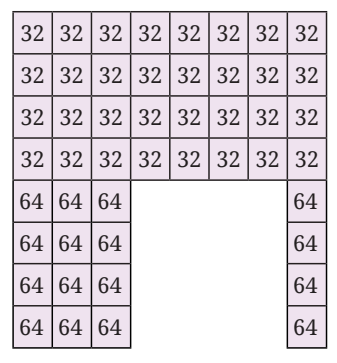
For example, adding numbers in certain figures can reveal a quicker method to find the sum rather than adding them one by one. 

image 171

The pattern in the grid consists of two distinct numbers: 32 and 64.

  • The number 32 occupies the majority of the grid, filling the top and left sections.
  • The number 64 is located in a rectangular block at the bottom right and in a vertical column on the left side.

An Unsolved Mystery — The Collatz Conjecture!

As stated in the chapter number play, the Collatz Conjecture is a famous unsolved problem in mathematics. The rule is simple:

  1. Start with any number.
  2. If the number is even, take half of it.
  3. If the number is odd, multiply it by 3 and add 1.
  4. Repeat.

Eventually, all sequences will reach the number 1, regardless of the whole number you start with.

Examples

  • 21, 64, 32, 16, 8, 4, 2, 1
  •  22, 11, 34, 17, 52, 26, 13, 40, 20, 10, 5, 16, 8, 4, 2, 1

Simple Estimation

According to the chapter number play, Sometimes, an estimate is enough instead of an exact count. 

Example

Paromita’s class section has 32 children. The other 2 sections of her class have 29 and 35 children. So, she estimated the number of children in her class to be about 100. 

Along with Class 6, her school also has Classes 7–10 and each class has 3 sections each. She assumed a similar number in each class and estimated the number of students in her school to be around 500.

Games and Winning Strategies

Numbers can also be used to play games and develop winning strategies.

Game #1

  • The first player says 1, 2, or 3.
  • Players take turns adding 1, 2, or 3 to the previous number.
  • The first player to reach 21 wins!

Play this game several times. Can you figure out the winning strategy? Which player can always win if they play correctly? There are many variations of this game

Game #2

  • The first player says a number between 1 and 10.
  • Players take turns adding a number between 1 and 10 to the previous number.
  • The first player to reach 99 wins!

Try this variation of the game and discover the winning strategy. You can also create your own variations of these games. Decide how much one can add at each turn and what number is the winning number. Play your version several times and figure out the winning strategy. And that’s it for th chapter number play.

In conclusion, the chapter Number Play in Mathematics for Class 6th offers an exciting journey through the fascinating world of numbers. It allows students to explore patterns, play with digits, and dive into interesting mathematical mysteries like palindromes, Kaprekar’s magic number, and the Collatz Conjecture. Number Play encourages creative thinking and strategic problem-solving, making learning numbers fun and engaging. With its focus on activities and games, Number Play helps students see numbers as more than just tools for calculation but as gateways to understanding deeper mathematical concepts. Whether it’s estimation, digit sums, or playing with numbers on the number line, Number Play provides a comprehensive foundation for mastering mathematics.


To read the NCERT text of  Class 6 Math Chapter 3 Number Play, click here.

Practice questions on Chapter 3 - Number Play

Get your free Chapter 3 - Number Play practice quiz of 20+ questions & detailed solutions

Practice Now

Math

Chapter 3 - Number Play

Power Up Learning with iPrep
Fill the Form to Begin!

Download the App

Watch lectures, practice questions and take tests on the go.

Number Systems- Complete Guide For Class 9 Math Chapter 1

Welcome to iPrep, your Learning Super App. Our learning resources for the chapter, Number Systems in Mathematics Class 9th Chapter 1 are designed to ensure that you grasp this concept with clarity and perfection. Whether you’re studying for an upcoming exam or strengthening your concepts, our engaging animated videos, practice questions and notes offer you the best of integrated learning with interesting explanations and examples.

This chapter introduces the real number systems, including rational and irrational numbers. It explores properties like closure, commutativity, associativity, and distributivity. The chapter “Number Systems” also covers the representation of real numbers on the number line, decimal expansions, and the concept of irrational numbers, including √2 and π.

Welcome to our comprehensive guide on “Number Systems,” the foundational chapter in Class 9 Mathematics. This chapter delves into the essential concepts of real numbers, exploring the different types, their properties, and how they interact. Here’s an overview of the topics covered in this chapter:

In this chapter, students will learn about:

  • The basic concepts of number systems.
  • Rational numbers and their decimal representations.
  • Irrational numbers and their unique properties.
  • Problems related to both rational and irrational numbers.
  • The representation of rational and irrational numbers on the number line.

Basics of Real Numbers

In the chapter “Number systems” of class 9 we will first learn about some basics of real numbers which are given below.

Natural Numbers: The counting numbers, starting from 1 (1, 2, 3, …), are known as natural numbers.

Whole Numbers: All natural numbers, along with zero, form the set of whole numbers (0, 1, 2, …).

Integers: This includes all positive and negative whole numbers, along with zero (-3, -2, -1, 0, 1, 2, …).

Now that we understand, the basics of real numbers, let us understand another very important aspect of the chapter – Number Systems, called Rational Numbers.

Introduction to Rational Numbers

According to the chapter Number Systems, Rational numbers are numbers that can be expressed in the form p/q, where p and q are integers, and q ≠ 0. Examples include 0, -3, 4/7, and -8/15.

  • Note: All natural numbers, whole numbers, and integers are considered rational numbers.

Representation of Rational Numbers

As stated in the chapter Number Systems, Rational numbers can be classified based on their decimal representation into:

  • Terminating Decimals: These decimals come to an end (e.g., 0.5, 0.28).
  • Non-Terminating, Repeating Decimals: These decimals repeat a pattern indefinitely (e.g., 0.333…, 2.142857…).

Irrational Numbers

Irrational numbers cannot be expressed in the form of p/q. Their decimal representations are non-terminating and non-repeating. Examples include √2 (1.414…) and √3 (1.73…).

Real Numbers

The set of all rational and irrational numbers forms the set of real numbers. Examples include 0, -3/2, 7, 2, 3, -1/5, 3/4, 1, and 8/7.

Problems With Rational Numbers

Students learn to:

  • Insert rational numbers between any two given rational numbers.
  • Represent decimal expressions as rational numbers.

For example, to insert five rational numbers between 2 and 3:

  • Convert the numbers to a common denominator and then select the numbers in between.

Representing decimal expressions as rational numbers.

In mathematics, any repeating or terminating decimal can be expressed as a fraction, which is a form of a rational number. Here’s how to convert various types of decimal expressions into their equivalent rational numbers:

1. Terminating Decimals

A terminating decimal is one that comes to an end. To convert a terminating decimal into a fraction:

  1. Write the decimal number over a power of 10 (depending on the number of decimal places).
  2. Simplify the fraction if necessary.

Example: Convert 0.75 into a fraction.

  • 0.75 = 75/100
  • Simplify: 75/100 = 3/4

2. Non-Terminating, Repeating Decimals

A repeating decimal has one or more repeating digits after the decimal point. To convert a repeating decimal into a fraction:

  1. Let x be the repeating decimal.
  2. Multiply x by a power of 10 such that the decimal part after the point repeats.
  3. Subtract the original x from this new expression to eliminate the repeating part.
  4. Solve for x.

Example: Convert 0.333… (where 3 repeats) into a fraction.

  • Let x = 0.333…
  • Multiply by 10: 10x=3.333…
  • Subtract the original equation: 10x − x = 3.333…−0.333…
  • 9x = 3 
  • x = 3/9 = 1/3

3. Non-Terminating, Non-Repeating Decimals

Non-terminating, non-repeating decimals cannot be represented as a fraction of integers, and thus are considered irrational numbers.

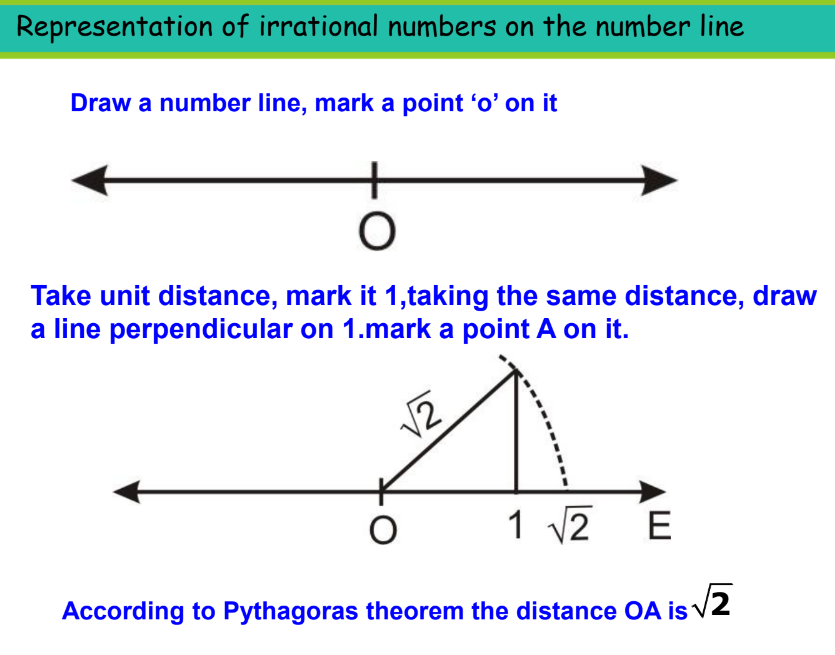
Representation of Irrational Numbers on the Number Line

A visual representation of irrational numbers on the number line from the chapter Number Systems

This section teaches how to locate irrational numbers, like √2, on the number line using geometric constructions based on the Pythagorean theorem.

Rationalization of Given Expressions

In the chapter Number Systems of class 9, this section involves removing irrational numbers from the denominator, making the expression rational.

Rationalize the expression: 3/√5−2

Multiply the numerator and the denominator by the conjugate:

 = 3/5−2 × (5+ 2/5+2)

= 3(5 + 2)/ (5−2) × (5+ 2)

= 35 + 6/1

= 35 + 6

Problems Related to Irrational Numbers

Students practice inserting irrational numbers between given numbers and representing them on the number line using successive magnification.

Insert irrational numbers between √2 and √3.

Solution: You know that the decimal representation of 2 and 3 are 1.414… and 1.732…respectively.

Now you can find any number greater than 1.414… and 1.73… such that it is non-terminating and non-repeating.

For example, we can take 1.50500500050000…

Hint: take any number of your choice whose value lies between the two given values.

Representing numbers by successive magnification methods

Represent 8.66 on the number line.

Solution: Step 1: Draw a number line

Step 2: 8.66 will lie between 8 and 9. So create 10 subdivisions between 8 and 9, locate 8.6

Step 3: 8.66 will lie between 8.6 and 8.7. Create 10 subdivisions between 8.6 and 8.7.

Step 3: 8.66 will lie between 8.6 and 8.7. Create 10 subdivisions between 8.6 and 8.7.

Step 4. The 6th division is 8.66

Exponents

Understanding positive and negative exponents, along with the laws governing integral exponents, is crucial in this chapter.

  • Positive Exponents: Indicate how many times to multiply the base by itself.
  • Negative Exponents: Represent the reciprocal of the base raised to the corresponding positive exponent.

Laws of Integral Exponents

According to the chapter Number Systems, Key laws of integral exponents include:

  • Multiplication: aᵐ × aⁿ = aᵐ ⁺ ⁿ
  • Division: aᵐ / aⁿ = aᵐ ⁻ ⁿ 
  • Power of a Power: (aᵐ)ⁿ = a ᵐ ˣ ⁿ

Powers with Negative Exponents

Can exponents be negative? Yes, they can! For example:

  • 5¹ = 5 
  • 5² = 5×5 = 25
  • 5⁰ = 1 (any number to the power of zero is 1)
  • 5⁻¹ = 1/5.  ​Negative exponents indicate reciprocals. Thus, 5⁻¹ means 1/5.

Properties of Irrational Numbers

The properties include:

  • The sum or difference between a rational and an irrational number is irrational.
  • The sum or difference of two irrational numbers can be either rational or irrational.
  • The product or quotient of two irrational numbers can also be rational or irrational.

Locating a Square Root on the Number Line

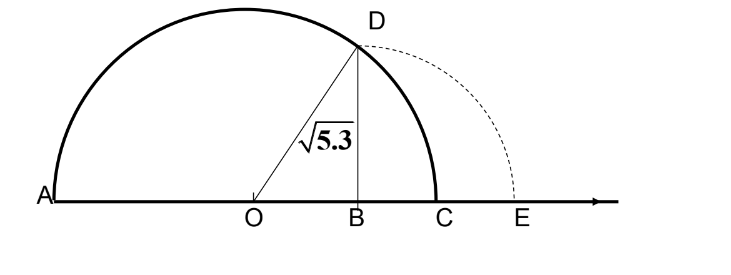
Using geometric methods, students learn to locate square roots of positive real numbers on the number line, such as finding the position of √5.3.

Step1: Draw a line and mark a point A on it.

Step 2: Mark a point B such that AB=5.3 cm.

Step 3: Mark a point C on AB produced such that BC=1 unit.

Step 4. Find the midpoint of AC. Let the midpoint be O.

Step 5. Taking O as the center, and radius OC=OA as the radius, draw a semi-circle. Also, draw a line passing through B perpendicular to OB. Suppose it touches the semi-circle at D.

Step 6. Taking B as center and BD as radius cut an arc on at point E.

image 244

This chapter lays a strong foundation for understanding different types of numbers and their properties, essential for further studies in mathematics. Dive into the exercises and examples to gain a deeper understanding of the number systems!

In conclusion, the Class 9 Math Chapter 1 “Number Systems” serves as a crucial building block in your mathematical journey. Through this chapter, you’ve explored the diverse realms of rational and irrational numbers, their properties, and their representation on the number line. By mastering these concepts, you’ll not only strengthen your foundational understanding but also be well-prepared for more advanced topics in mathematics.

The chapter “Number Systems” intricately covers everything from the basics of real numbers to the complexities of irrational numbers and their rationalization. By engaging with the chapter’s content, including its problems and examples, you will develop a robust comprehension of how numbers function and interact. Remember, whether it’s understanding rational numbers, representing them on the number line, or dealing with irrational numbers, this chapter provides you with the essential tools needed for future mathematical challenges.

Dive deep into the chapter “Number Systems,” practice diligently, and use the resources available to you. Embrace the fascinating world of numbers and let this chapter be a stepping stone towards excelling in your math studies. Happy learning!

Practice questions on Chapter 1 - Number Systems

Get your free Chapter 1 - Number Systems practice quiz of 20+ questions & detailed solutions

Practice Now
Math

Chapter 1 - Number Systems

Power Up Learning with iPrep
Fill the Form to Begin!

Download the App

Watch lectures, practice questions and take tests on the go.