Linear Equation in Two Variables- Complete Guide For Class 9 Math Chapter 4

Welcome to iPrep, your Learning Super App. Our learning resources for the chapter, Linear Equation in Two Variables in Mathematics Class 9th chapter 4 are designed to ensure that you grasp this concept with clarity and perfection. Whether you’re studying for an upcoming exam or strengthening your concepts, our engaging animated videos, practice questions and notes offer you the best of integrated learning with interesting explanations and examples.

Chapter 4 of Class 9 Mathematics, “Linear Equations in Two Variables,” introduces students to equations of the form ax + by + c = 0. It covers the representation of these equations graphically, solutions as points on a line, and applications in real-life situations.

Introduction to Linear Equations

as stated in the chapter Linear Equation in two variables, A linear equation in one variable is an equation of the form ax + b = 0, where a and b are real numbers. For example, consider the equation:

3x + 2 = 0

The solution is found by isolating x:

3x = −2

x = −2/3 ​

This equation has one unique solution.

Representation on the Number Line

Let’s consider the equation:

2x + 4 = 8 

To solve for x, we simplify:

2x = 4 

x = 2 

This solution can be represented on the number line, providing a visual understanding of the solution’s position.
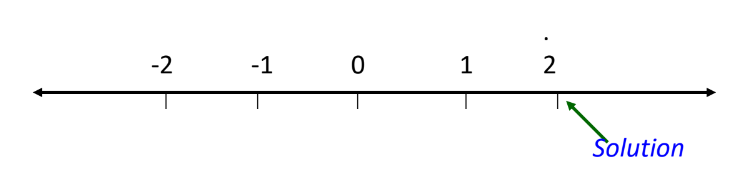
a visual representation of the representation of liner equation on the number line from class 9 math chapter 4 - Linear Equation in Two Variables

Key Points to Remember

  1. The solution of a linear equation is not altered if:
    • The same value is added to both sides.
    • The same value is subtracted from both sides.
    • Both sides are multiplied or divided by the same value.
  1. Linear Equations in Two Variables: An equation of the form ax + by + c = 0 (where a,b and c are real numbers and a ≠ 0, b ≠ 0) is known as a linear equation in two variables.

Example: 

2x + 3y = 23 

Here, a = 2, b = 3, and c = − 23. The equation can be rearranged into its standard form.

Solving Linear Equations

Example: Prove that x = 3 and y = 2 is a solution to the equation:

3x − 2y = 5

Solution: Substitute x = 3 and y = 2:

3(3) − 2(2) = 9 − 4 = 5

Hence, x = 3 and y = 2 is indeed a solution.

Representing Real-World Problems

Example 1: The cost of a pen and twice the cost of a pencil is 146. Represent this situation algebraically.

Solution: Let x be the cost of the pen and y the cost of the pencil:

x + 2y = 146

Example 2: Rahul and Ankur together contributed Rs. 100 for a donation camp. Write a linear equation to represent this.

Solution: Let x and y be the contributions of Rahul and Ankur, respectively:

x + y = 100

Identifying Coefficients

Example: In the equation x/2 + y = 1.76, identify the values of a,b, and c.

Solution: Here, a = 1/2​, b=1 and c = −1.7.

Finding Solutions

A linear equation in two variables can have infinite solutions. For example:

Example: Find four solutions for the equation x + y = 4.

Solution:

      xy
      0          4
      1          3
      2          2
      3          1

Similarly, for the equation 2x + y = 7, we can find:

      xy
      0          7
      1          5
      2          3
      3          1

Graphical representation of linear equation in two variables

Now that we know very well about the linear equations in two variables for class 9 chapter 4, we will now see how to represent these linear equations with the help of graphs.
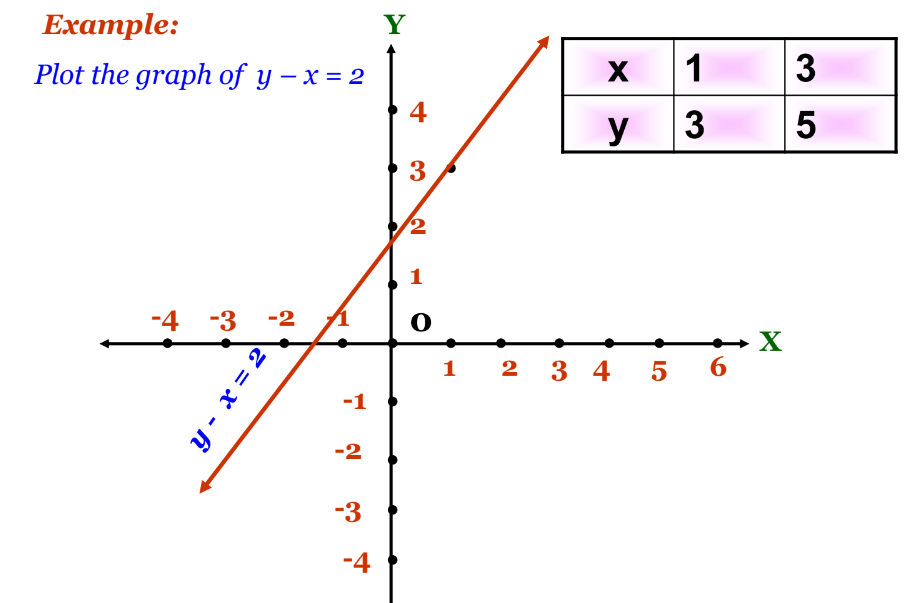
a Graphical representation of linear equation in two variables from class 9 math

Checking Solutions

Example: Determine if the following are solutions for the equation x − 2y = 4:

  1. (2,4)
  2. (4,0)
  3. (−1,1)

Solution:

  • (2,4) is not a solution.
  • (4,0) is a solution.
  • (−1,1) is not a solution.

Special Cases and Graphical Representation

Example: Find m if x = −1 and y = −2 is a solution for 4x − 3y = m.

Solution: Substitute x and y values:

4(−1) − 3(−2) = m

−4 + 6 = m

m = 2 

Graphical Representation

Plotting the equation y − x = 2 involves finding points and drawing a line through them. Similarly, x − 2y = 3 and 3x − 2y = 4 are plotted by finding suitable x,y pairs.

The graphical method provides a visual representation of linear equations, showcasing how each equation forms a line on the Cartesian plane. A key aspect is that any line parallel to the x – axis has y = constant and parallel to the y – axis has x = constant.

This chapter serves as a fundamental building block for understanding more complex mathematical concepts and their practical applications. Whether in algebraic or graphical form, mastering linear equations in two variables is crucial for students in Class 9 and beyond.

In conclusion, Chapter 4: Linear Equation in Two Variables is a foundational topic in Class 9 Mathematics. By mastering the concepts covered in this chapter, such as solving equations, representing them graphically, and applying them to real-world situations, students gain critical problem-solving skills. Whether you’re dealing with equations like ax+by+c=0ax + by + c = 0ax+by+c=0 or exploring the infinite solutions of linear equations, this chapter sets the stage for more advanced mathematical learning. The iPrep Learning Super App offers a variety of resources to help you excel in Chapter 4: Linear Equation in Two Variables, ensuring a comprehensive understanding of these essential concepts. Keep practicing, and you’ll soon master the principles of Chapter 4: Linear Equation in Two Variables!

Practice questions on Chapter 4 - Linear Equation in Two Variables

Get your free Chapter 4 - Linear Equation in Two Variables practice quiz of 20+ questions & detailed solutions

Practice Now

Math

Chapter 4 - Linear Equation in Two Variables

Power Up Learning with iPrep
Fill the Form to Begin!

Download the App

Watch lectures, practice questions and take tests on the go.

Prime Time – Awesome Guide For Class 6 Math Chapter 5

Welcome to iPrep, your Learning Super App. Our learning resources for the chapter, Prime Time in Mathematics for Class 6th are designed to ensure that you grasp this concept with clarity and perfection. Whether you’re studying for an upcoming exam or strengthening your concepts, our engaging animated videos, practice questions and notes offer you the best of integrated learning with interesting explanations and examples. 

The chapter Prime Time introduces students to the fundamental concepts of prime and composite numbers. It explores the idea that a prime number has exactly two distinct factors: 1 and the number itself, while a composite number has more than two factors. The chapter also covers the concept of divisibility, helping students understand how to determine if one number is divisible by another. Additionally, students learn about the importance of prime factorization, which involves breaking down a number into its prime factors, a crucial skill that lays the foundation for more advanced topics in mathematics.

Prime Time

Common Multiples and Common Factors

Let’s start the chapter of prime time with a fun game (Idli-Vada Game) that you can play with your friends! Imagine you’re sitting in a circle with other children, and the game is all about numbers.

  • One child starts by saying “1”.
  • The second player says “2”, and so on.
  • But when it’s the turn of multiples of 3 (like 3, 6, 9…), the player should say “idli” instead of the number.
  • When it’s the turn of multiples of 5 (like 5, 10, 15…), the player should say “vada” instead of the number.
  • If a number is a multiple of both 3 and 5 (like 15), the player should say “idli-vada”!

If a player makes a mistake, they are out of the game. The game continues in rounds until only one player remains.

Key Questions:

  • For which numbers should players say “idli”? These would be 3, 6, 9, 12, 15, 18, and so on.
  • For which numbers should players say “vada”? These would be 5, 10, 15, 20, 25, and so on.
  • Which is the first number for which players should say “idli-vada”? The answer is 15, as it is a multiple of both 3 and 5. Such numbers are called Common Multiples.

Jump Jackpot: A Game of Multiples

Let’s understand the chapter prime time further with a game. In this game, Jumpy and Grumpy are playing a treasure hunt game. Grumpy places a treasure on a number, say 24, and Jumpy has to jump on multiples of a chosen jump size, starting from 0, to reach the treasure.

For example, if Jumpy chooses a jump size of 4, he will jump on 4 → 8 → 12 → 16 → 20 → 24, successfully landing on 24.

Other successful jump sizes for 24 include 2, 3, 6, 8, 12, and 24.

But what happens if there are two treasures, placed on different numbers like 14 and 36? Jumpy needs to choose a jump size that lands on both numbers.

  • Factors of 14: 1, 2, 7, 14
  • Factors of 36: 1, 2, 3, 4, 6, 9, 12, 18, 36

Common Factors of 14 and 36 are 1 and 2. So, Jumpy should choose a jump size of 1 or 2 to land on both treasures. 

Common Factors or Divisors are the numbers that can divide both numbers exactly.

Perfect Numbers

As stated in the chapter prime time, a number for which the sum of all its factors is equal to twice the number is called a Perfect Number

The number 28 is an example of a perfect number. Its factors are 1, 2, 4, 7, 14, and 28. Now let’s explore another very important topic of the chapter Prime Time, named perfect numbers.

Prime Numbers

Definition: Numbers with only two factors are called Prime Numbers.

Example:

Guna and Anshu are arranging figs (anjeer) in boxes.

  • Guna wants to put 12 figs in each box.
  • Anshu wants to put 7 figs in each box.

Guna can arrange the 12 figs in multiple ways:

  • 1 row of 12 figs
  • 2 rows of 6 figs
  • 3 rows of 4 figs
  • 4 rows of 3 figs
  • 6 rows of 2 figs

However, Anshu can only arrange the 7 figs in one way:

  • 1 row of 7 figs

This difference is because 12 has more than two factors, while 7 has only two factors—1 and 7. Now let’s explore another topic of the chapter prime time named Prime vs. Composite Numbers.

Prime vs. Composite Numbers

  • Prime Numbers have only two factors: 1 and the number itself. Examples include 2, 3, 5, 7, 11, 13, 17, 19.
  • Composite Numbers have more than two factors. Examples include 4, 6, 8, 9, 10, 12, 14, 15, 16, 18, 20.

Note: The number 1 is neither a prime nor a composite number.

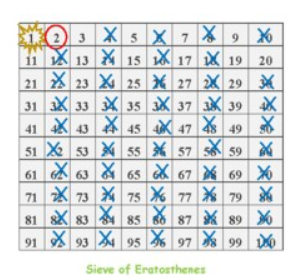
The Sieve of Eratosthenes: Finding Prime Numbers

image 178

Here’s an ancient method to find prime numbers:

  1. Cross out 1 because it is neither prime nor composite.
  2. Circle 2, then cross out all multiples of 2.
  3. Circle 3, then cross out all multiples of 3.
  4. Circle 5, then cross out all multiples of 5.

Continue this process until all numbers are either circled (primes) or crossed out (composites). This method is called the Sieve of Eratosthenes. Now let’s explore the another topic of prime time names twin primes.

Twin Primes

According to the chapter Prime Time, twin primes are pairs of prime numbers with a difference of 2. Examples include 3 and 5, 17 and 19. 

Co-prime Numbers: Safe Keeping Treasures

In the treasure hunt game, Jumpy has to reach two treasures placed on different numbers using the same jump size, but with a new rule: the jump size of 1 is not allowed.

To ensure Jumpy cannot reach both treasures, Grumpy should place them on numbers that have no common factors other than 1, called Co-prime Numbers.

For example:

  • 12 and 26 are not co-prime because they have a common factor of 2.
  • 4 and 9 are co-prime because they have no common factors other than 1.

Prime Factorisation: Breaking Down Numbers

As stated in the chapter Prime Time, when checking if two numbers are co-prime, a systematic approach called Prime Factorisation is used.

For example:

  • Prime Factorisation of 56: 56 = 2 × 2 × 2 × 7
  • Prime Factorisation of 63: 63 = 3 × 3 × 7

These factors are all primes, and the product of these prime factors gives the original number.

Key Points:

  • Every number greater than 1 has a prime factorization. 
  • The idea is the same: keep breaking the composite numbers into factors till only primes are left. 
  • The number 1 does not have any prime factorization. It is not divisible by any prime number.

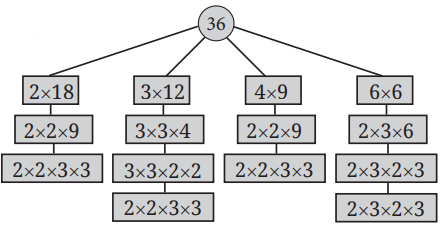
Here, you see four different ways to get a prime factorization of 36. Observe that in all four cases, we get two 2s and two 3s. Multiply back to see that you get 36 in all four cases.

An illustration of prime factorization from the chapter prime time from class 6 math

Does the order matter?

When multiplying numbers, we can do so in any order. The end result is the same. That is why, when two 2s and two 3s are multiplied in any order, we get 36.

Thus, the order does not matter. Usually, we write the prime numbers in increasing order. For example, 225 = 3 × 3 × 5 × 5 or 30 = 2 × 3 × 5. 

Prime Factorization of a Product of Two Numbers

When we perform prime factorization, we start by expressing a number as a product of two factors. For example, 72 can be written as 12 × 6. We then find the prime factorization of each factor:

  • 12 = 2 × 2 × 3
  • 6 = 2 × 3

By combining these, the prime factorization of 72 is:

  • 72 = 2 × 2 × 3 × 2 × 3
  • This can also be written as 2 × 2 × 2 × 3 × 3.

Always remember to multiply the factors to verify that you get the original number, 72, in this case. 

Notice how each prime factor appears a specific number of times in the factorization of 72, compared to how they appear in the factorization of 12 and 6 individually.

Using Prime Factorization to Check Co-prime Numbers

Co-prime numbers are pairs of numbers that have no common prime factors. Let’s explore this with an example:

  • 56 = 2 × 2 × 2 × 7
  • 63 = 3 × 3 × 7

Since 7 is a common prime factor in both 56 and 63, they are not co-prime.

Consider another pair:

  • 80 = 2 × 2 × 2 × 2 × 5
  • 63 = 3 × 3 × 7

Here, there are no common prime factors, so 80 and 63 are co-prime.

Additional Examples:

  • 40 = 2 × 2 × 2 × 5
  • 231 = 3 × 7 × 11

Since they have no common prime factors, 40 and 231 are co-prime.

  • 242 = 2 × 11 × 11
  • 195 = 3 × 5 × 13

Again, no common prime factors exist, so 242 and 195 are co-prime.

Using Prime Factorization to Check Divisibility

If one number is divisible by another, the prime factorization of the second number will be a part of the prime factorization of the first. Let’s look at an example:

Example 1: Is 168 divisible by 12?

  • 168 = 2 × 2 × 2 × 3 × 7
  • 12 = 2 × 2 × 3

Since the prime factors of 12 are included in the prime factorization of 168, 168 is divisible by 12.

Example 2: Is 75 divisible by 21?

  • 75 = 3 × 5 × 5
  • 21 = 3 × 7

Since 7 is a prime factor of 21 but not of 75, 75 is not divisible by 21.

Example 3: Is 42 divisible by 12?

  • 42 = 2 × 3 × 7
  • 12 = 2 × 2 × 3

Since factor 2 appears twice in 12 but only once in 42, 42 is not divisible by 12.

Divisibility Tests: Simplifying Factorization for Large Numbers

As stated in the chapter Prime Time, finding factors of smaller numbers is straightforward, but what about larger numbers? 

Let’s take 8560 as an example. Does it have any factors from 2 to 10? 

We can easily determine this without long division by applying simple divisibility rules.

  1. Divisibility by 10

       To check if a number is divisible by 10, observe the last digit:

  • Numbers ending in 0 are divisible by 10.

             Example: Is 8560 divisible by 10?

                                Yes, because it ends in 0.

  1. Divisibility by 5

             Similarly, a number is divisible by 5 if it ends in 0 or 5.

            Example: Is 8560 divisible by 5?

                   Yes, because it ends in 0.

  1. Divisibility by 2

              A number is divisible by 2 if its last digit is 0, 2, 4, 6, or 8.

              Example: Is 8560 divisible by 2?

                 Yes, because it ends in 0.

  1. Divisibility by 4

Checking divisibility by 4 involves looking at the last two digits. If they form a number divisible by 4, then the whole number is divisible by 4.

              Example: Is 8536 divisible by 4?

                 Yes, because 36 is divisible by 4.

  1. Divisibility by 8

For divisibility by 8, check the last three digits. If they form a number divisible by 8, then the entire number is divisible by 8.

             Example: Is 8560 divisible by 8?

                  No, because 560 is not divisible by 8.

Special Numbers and Fun with Prime Numbers

As stated in the chapter Prime Time, special numbers often have unique characteristics. 

Let’s explore some examples:

Consider the numbers 9, 16, 25, 43. Each has something special:

  • 9 is the only single-digit number.
  • 16 is the only even number and a multiple of 4.
  • 25 is the only multiple of 5.
  • 43 is the only prime number and not a perfect square.

A Prime Puzzle

Lastly, try your hand at a prime number puzzle! It’s a fun way to engage with primes and their properties.

Rules:  Fill the grid with prime numbers only so that the product of each row is the number to the right of the row and the product of each column is the number below the column.

Example:

      75
      42
      102
170 30 63 X

Solution

5 5 3 75
2 3 7 42
17 2 3 102
170 30 63 X

In conclusion, Chapter 5 of CBSE Class 6th Math, “Prime Time,” provides a foundational understanding of prime and composite numbers, along with essential concepts such as divisibility, common factors, and prime factorization. By exploring the distinction between prime and composite numbers, students can build a strong mathematical base. Prime Time is filled with interactive games and activities that make learning these topics engaging and fun. Whether it’s understanding prime factorization or playing with common multiples, the lessons in Prime Time are crucial for grasping higher-level math concepts. Be sure to explore all the resources iPrep offers for Prime Time to master these essential math skills!


To read the NCERT text of  Maths Chapter 5 Prime Time, click here.

Practice questions on Chapter 5 - Prime Time!

Get your free Chapter 5 - Prime Time! practice quiz of 20+ questions & detailed solutions

Practice Now

Math

Chapter 5 - Prime Time!

Power Up Learning with iPrep
Fill the Form to Begin!

Download the App

Watch lectures, practice questions and take tests on the go.

Human Resources – Complete Guide For Class 8 Geography Chapter 5

Welcome to iPrep, your Learning Super App. Our learning resources for the chapter, “Human Resources” in Geography for Class 8th are designed to ensure that you grasp this concept with clarity and perfection. Whether you’re studying for an upcoming exam or strengthening your concepts, our engaging animated videos, practice questions and notes offer you the best of integrated learning with interesting explanations and examples. 

The chapter ‘Human Resources’ in the Class 8 Geography NCERT book provides a comprehensive overview of the importance and dynamics of human resources. The chapter delves into the distribution, density, and factors influencing population patterns. By examining population change, its patterns, and composition, students gain a nuanced understanding of human resources and their crucial role in shaping societies. Understanding these elements is vital for grasping how populations interact with their environments and the implications for development.

Objectives of the Chapter

Now that we understand the importance of studying this chapter, let’s explore the objectives behind the chapter ‘Human Resources’.

  • To understand how and why populations are spread unevenly across different regions and countries, influenced by geographical and socio-economic factors.
  • To learn about the concept of population density, including how to measure it and the factors that contribute to variations in density across different areas.
  • To identify and analyze the physical and human factors that influence the distribution of populations, such as climate, resources, economic opportunities, and historical events.
  • To explore the dynamics of population change, including birth rates, death rates, and migration patterns, and understand how these factors affect the overall size and structure of populations.
  • To examine historical and current trends in population growth and decline, and recognize patterns such as rapid growth in certain regions and aging populations in others.
  • To analyze the demographic characteristics of populations, including age, sex, and occupation, and understand how these characteristics impact social and economic structures.

Let’s now understand the various sections of the chapter in detail.

First of all, to understand the distribution of population, let’s delve into the section “Distribution of Population” in the chapter “Human Resources.”

Distribution of Population

  • This section explores how populations are spread across different regions, influenced by various geographical, economic, and social factors. 
  • By examining patterns of population distribution, students gain insight into why some areas are densely populated while others are sparsely inhabited. 
  • Understanding these patterns is crucial for grasping the complexities of human geography and the factors that shape our global population landscape.
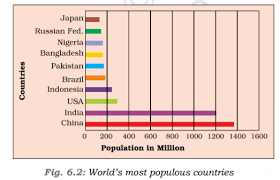
a graphical representation of the world's most populated countries from class 8 geography chapter 5 - Human Resources

Now, to understand the Density of Population, let us delve into the section Density of Population of the chapter Human Resources

Density of Population

  • This section examines how population density is measured and varies across different regions. 
  • It highlights the number of people living per unit area and explores the implications of high or low density on resources, infrastructure, and living conditions. 
  • Understanding population density is essential for analyzing demographic trends and planning for sustainable development in various parts of the world.
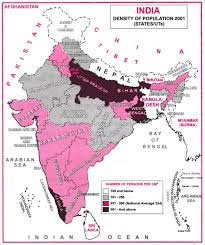
a visual representation of density of population from class 8 geography chapter 5 - human resources

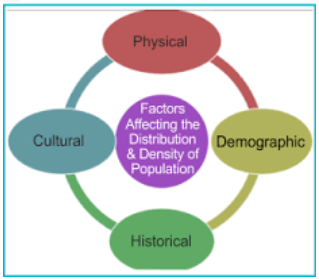
Now, to understand the Factors Affecting the Distribution of Population, let us delve into the section Factors Affecting Distribution of Population of the chapter Human Resources

Factors Affecting The Distribution of Population

  • This section explores the various elements that influence how and why populations are spread across different regions. 
  • Key factors such as climate, topography, economic opportunities, and historical developments shape population distribution. 
  • By examining these factors, we gain insight into patterns of human settlement and the reasons behind varying population densities around the world.
a visual representation of Factors Affecting Distribution of Population from class 8 geography chapter 5 - human resources

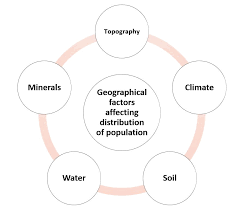
The section ‘Factors Affecting Distribution of Population’ covers certain key points. Lets discuss them below.

Geographical Factors

  1. Topography:
    • Plains are preferred for settlement due to their suitability for farming, manufacturing, and service activities.
    • The Ganga plains are among the most densely populated areas globally, while mountains like the Andes, Alps, and Himalayas are sparsely populated.
  2. Climate:
    • Extreme climates (very hot or very cold) are generally avoided.
    • Regions like the Sahara Desert, and polar areas of Russia, Canada, and Antarctica have sparse populations.
  3. Soil:
    • Fertile soils support agriculture and attract dense populations.
    • Examples: Ganga and Brahmaputra plains in India, Hwang-He and Chang Jiang in China, and the Nile in Egypt.
  4. Water:
    • Access to fresh water is a major factor for dense settlements.
    • River valleys are densely populated, while deserts have sparse populations.
  5. Minerals:
    • Areas with mineral deposits attract populations.
    • Examples: Diamond mines in South Africa, oil deposits in the Middle East.
a visual representation of geographical Factors Affecting Distribution of Population from class 8 geography chapter 5 - human resources

Social, Cultural, and Economic Factors

  1. Social:
    • Areas with better housing, education, and healthcare are more densely populated.
    • Example: Pune.
  2. Cultural:
    • Places with religious or cultural significance attract people.
    • Examples: Varanasi, Jerusalem, Vatican City.
  3. Economic:
    • Industrial areas offer employment opportunities and attract large populations.
    • Examples: Osaka in Japan, and Mumbai in India.

Now, to understand the Population Change, let us delve into the section Population Change of the chapter Human Resources

Population Change

  • This section examines the dynamics of how populations evolve over time due to factors such as birth rates, death rates, and migration. 
  • It provides an understanding of how and why population sizes fluctuate and the implications of these changes on societies and economies. 
  • Studying population change helps in grasping the broader impacts on resources, infrastructure, and social service. 
a visual representation of population change from class 8 geography chapter 5 - human resources

The section “Population Change” highlights several important points. Let’s discuss them below.

  1. Definition of Population Change

Population change refers to the variation in the number of people over a specific period. This change is primarily influenced by the number of births and deaths within that time frame.

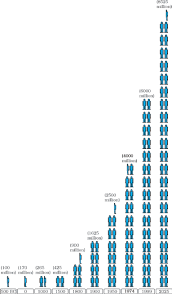
  1. Historical Population Growth

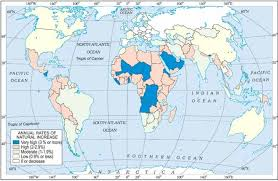
Historically, population growth was slow and steady until the 1800s, mainly due to high infant mortality rates and inadequate health facilities and food supplies. In 1804, the global population reached one billion. By 1959, it had grown to three billion, a phenomenon often termed the “population explosion.” By 1999, the population had doubled to six billion, driven by improvements in food supply and medical care that lowered death rates while birth rates remained high.

  1. Measurement of Births and Deaths

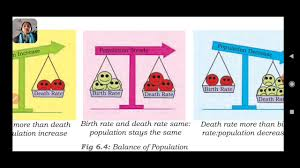
The measurement of births and deaths is crucial in understanding population dynamics. The birth rate is defined as the number of live births per 1,000 people, while the death rate is the number of deaths per 1,000 people.

  1. Natural Causes of Population Change

Natural causes of population change include the difference between birth rates and death rates, known as the natural growth rate. A rapid increase in the natural growth rate has been a significant factor in the global population rise.

  1. Migration

Migration involves the movement of people into and out of an area. Emigrants are individuals who leave a country, while immigrants are those who arrive in a new country. Countries like the USA and Australia have seen population growth due to immigration, whereas countries like Sudan have experienced population loss due to emigration. International migrations generally flow from less developed nations to more developed ones in search of better employment opportunities. Additionally, within countries, many people move from rural areas to urban centers for jobs, education, and healthcare.

  1. Glossary

Life Expectancy: This term refers to the average number of years a person can expect to live. It is a critical indicator of the overall health and well-being of a population.

a visual representation of balance of Population from class 8 geography chapter 5 - human resources

Now, to understand the Patterns of Population Change, let us delve into the section Patterns of Population Change of the chapter Human Resources

Patterns of Population Change 

  • This section explores the different trends and variations in population growth and decline across regions and periods. 
  • By examining these patterns, we can better understand how demographic shifts affect economic development, urbanization, and resource distribution. 
  • Analyzing these patterns helps in anticipating future demographic challenges and planning for sustainable growth and development.
a visual representation of patterns of Population change from class 8 geography chapter 5 - human resources

Now, to understand the Population Composition, let us delve into the section Population Composition of the chapter Human Resources

Population Composition

  • This section examines the structure of a population in terms of age, sex, occupation, and other demographic characteristics. 
  • Understanding population composition helps in assessing the social and economic needs of a region, as well as planning for healthcare, education, and employment. 
  • This analysis provides insights into the workforce dynamics and the overall well-being of a society.

The section “Population Composition” highlights several important points. Let’s discuss them below.

  1. Economic Development and Population Density

High population density does not always mean economic prosperity. For example, both Bangladesh and Japan are densely populated, but Japan is much more economically developed. This shows that factors like industrialization, education, and infrastructure play a crucial role in economic development beyond just population numbers.

  1. Understanding Population Composition

Population composition involves examining age, sex, literacy, health, occupation, and income levels. This analysis helps understand the human resources available and aids in planning for education, healthcare, and employment to meet the population’s needs effectively.

  1. Significance of Population Composition

Knowing the population composition is essential for identifying demographic characteristics such as age, gender, education, occupation, and income levels. This information is crucial for creating targeted policies and programs to improve overall quality of life.

  1. Population Pyramid (Age-Sex Pyramid)

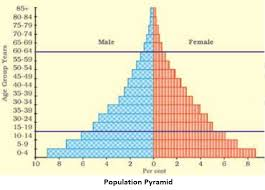
A population pyramid visually represents a population divided into age groups and further split into males and females. The shape of the pyramid reveals trends in birth rates, death rates, and life expectancy, offering a snapshot of the population’s structure.

a visual representation of Population Pyramid differentiated based on age and sex from class 8 geography chapter 5 - human resources
  1. Interpreting Population Pyramids

Population pyramids help understand demographic characteristics by showing the number of children, adults, and elderly in a population. They indicate whether a population is growing, stable, or declining, and reveal the ratio of dependents to the economically active population.

  1. Examples of Population Pyramids

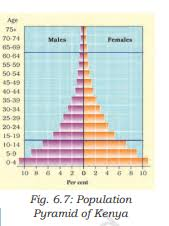
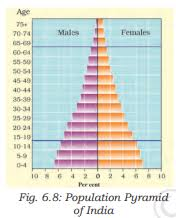
Kenya’s population pyramid has a broad base and narrows quickly, indicating high birth and death rates. India’s pyramid shows a broad base and steady narrowing, reflecting lower death rates among the young. Japan’s narrow base and wider top show low birth rates and a large elderly population.

a visual representation of Population Pyramid of Kenya from class 8 geography chapter 5 - human resources
  1. Importance of Youth

Young people are a vital resource for any nation. In India, investing in education and skills for the youth can drive economic growth and innovation. A supportive environment for young people ensures a robust and dynamic future workforce.

a visual representation of Population Pyramid Of India from class 8 geography chapter 5 - human resources

Now that we have discussed the whole chapter, let us know the overall learning value of the chapter “Human Resources”. 

Overall Learning Value of the Chapter

The chapter on ‘Human Resources’ is essential for understanding the various dimensions of population dynamics and their impact on society. By studying distribution, density, change, patterns, and composition, students gain valuable insights into how human resources shape and are shaped by their environments. This knowledge is crucial for addressing challenges related to population management and development.

In conclusion, CBSE Class 8th Geography Chapter, “Human Resources,” provides students with a deep understanding of the factors that influence population distribution, density, and composition. It emphasizes the critical role human resources play in shaping societies and economic structures. By exploring topics such as population change, migration, and demographic characteristics, students are equipped with the knowledge to analyze how human resources interact with the environment. Whether you’re preparing for an exam or building a solid foundation in geography, iPrep offers comprehensive resources for mastering the Chapter “Human Resources.” Dive into our engaging videos, detailed notes, and practice questions to strengthen your grasp of the chapter “Human Resources” and succeed in your studies!

Practice questions on Chapter 5 - Human Resources

Get your free Chapter 5 - Human Resources practice quiz of 20+ questions & detailed solutions

Practice Now
Geography

Chapter 5 - Human Resources

Power Up Learning with iPrep
Fill the Form to Begin!

Download the App

Watch lectures, practice questions and take tests on the go.

Polynomials- Complete Guide Class 9 Math Chapter 2

Welcome to iPrep, your Learning Super App. Our learning resources for the chapter, Polynomials in Mathematics Class 9th chapter 2 are designed to ensure that you grasp this concept with clarity and perfection. Whether you’re studying for an upcoming exam or strengthening your concepts, our engaging animated videos, practice questions and notes offer you the best of integrated learning with interesting explanations and examples.

Chapter 2, “Polynomials,” in Class 9 Mathematics explores algebraic expressions consisting of variables and coefficients. It covers definitions, types, degrees, and zeros of polynomials, along with algebraic identities and their applications. The chapter provides foundational knowledge for understanding polynomial equations and their properties.

Polynomials are an integral part of algebra, offering a foundation for various mathematical concepts. This chapter explores the fascinating world of polynomials, breaking down complex ideas into digestible pieces for Class 9 students.

Basic Concepts: Building Blocks of Polynomials

Constants: These are fixed numerical values, such as 5, 100, or 3.

Variables: Unlike constants, variables can take different values. Common examples include x, y, z, a, b, and c.

Algebraic Expressions: These are combinations of variables and constants separated by addition or subtraction. For instance, the area of a square with side x is represented as x², an algebraic expression.

Understanding Polynomials

A polynomial is a specific type of algebraic expression with non-negative exponential powers. For example, x² – 2xy + y² is a polynomial with two variables, x and y. Similarly, x⁴ + 4x³ – 2x² + 7x – 5 is a polynomial with the variable x.

Terms and Coefficients: In the polynomial f(x) = aₙxⁿ + aₙ₋₁xⁿ⁻¹ + … + a₀, each part like aₙxⁿ is a term, and the numerical factors like aₙ are coefficients.

Classifying Polynomials by Terms

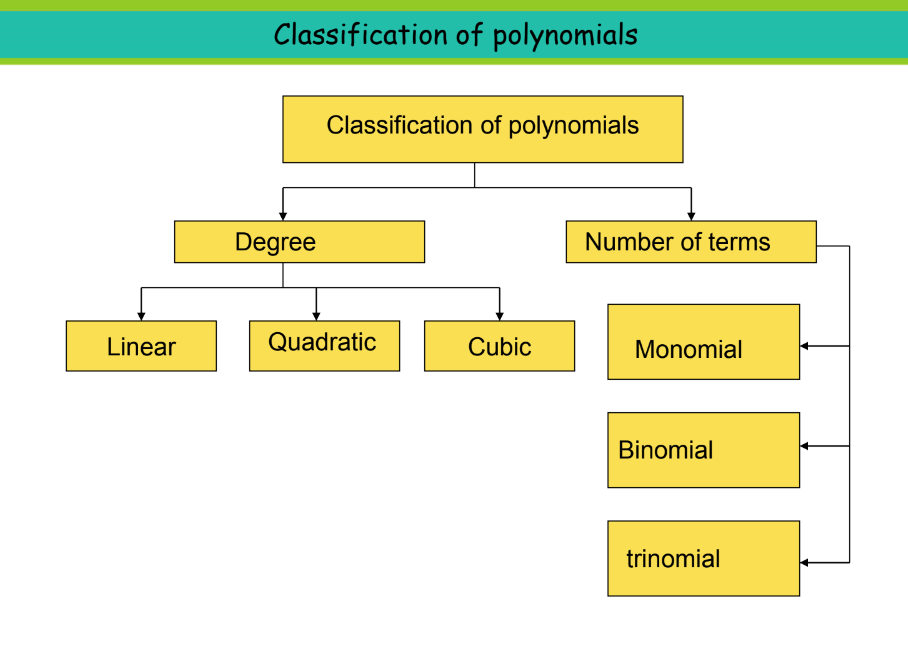
Monomials: Polynomials with a single term, such as x² or 2x.

Binomials: Polynomials with two terms, like x² + 3 or 2xy – 8.

Trinomials: Polynomials with three terms, such as y³ – 3y² + 8.

Determining the Degree of a Polynomial

The degree of a polynomial is the highest power of its variable. For example, the polynomial y⁴ – 3y³ + 7x + 8 has a degree of 4. Based on their degree, polynomials can be classified as:

Linear: Degree 1 (e.g., x + 4) 

Quadratic: Degree 2 (e.g., x² + 2x + 1) 

Cubic: Degree 3 (e.g., x³ – 3x² + 2x + 5)

Value and Zeros of Polynomials

The value of a polynomial at a specific point can be found by substituting the variable with the given number. For example, f(x) = 2x³ – 3x² + 4x – 2 at x = 2 gives f(2) = 10.

Zeros of a Polynomial: A zero (or root) of a polynomial is a value that makes the polynomial equal to zero. For instance, in the polynomial x³ – 6x² + 11x – 6, x = 2 is a root because f(2) = 0.

Finding Zeros of Polynomials

For a linear equation like ax + b = 0, the zero is -b/a. For quadratic equations, roots can be found using methods such as splitting the middle term.

Classification Of Polynomials

Now, with the help of the image given below, we will see the classification of polynomials for class 9 Mathematics Chapter 2

a tabular representation of classification of polynomials from class 9 math

Division of Polynomials

Just like integers, polynomials can be divided, yielding a quotient and a remainder. For example, dividing y³ + y² + 2y + 3 by y + 2 gives a quotient of y² – y + 4 and a remainder of -5.

Remainder Theorem: This theorem states that the remainder of a polynomial f(x) when divided by x – a is f(a).

Factor Theorem: This theorem links the zeros of a polynomial to its factors. It states that (x – a) is a factor of a polynomial f(x) if and only if f(a) = 0.

Factorization Techniques Of Polynomials

Polynomials can be factorized in various ways:

  1. Common Factors: Identifying common factors in each term.
  2. Grouping: Combining like terms for factorization.
  3. Perfect Squares: Utilizing identities like (a + b)² = a² + 2ab + b².
  4. Difference of Squares: Applying a² – b² = (a – b)(a + b).
  5. Splitting the Middle Term: Commonly used for quadratic polynomials.
  6. Cubic Identities: Utilizing formulas like (a + b)³ = a³ + 3a²b + 3ab² + b³.

Conclusion

This chapter provides a solid foundation for understanding and working with polynomials, from basic definitions to complex factorization techniques. As you delve into these concepts, you’ll gain a deeper appreciation for the beauty and utility of algebraic expressions in mathematics.

For more detailed explanations and examples, feel free to explore our resources and join our community discussions!

Practice questions on Chapter 2 - Polynomials

Get your free Chapter 2 - Polynomials practice quiz of 20+ questions & detailed solutions

Practice Now
Math

Chapter 2 - Polynomials

Power Up Learning with iPrep
Fill the Form to Begin!

Download the App

Watch lectures, practice questions and take tests on the go.